

Move-In Is the New Renewal Strategy for Multifamily Operators
Renewal starts earlier than most teams think
For years, multifamily operators have treated renewal as a back-half-of-the-lease conversation.
It shows up when teams start watching pricing, notice activity, concessions, occupancy pressure, and resident sentiment more closely. Outreach begins. Intent gets measured. The goal is to influence the decision before the resident starts actively shopping the market.
But the real renewal story often starts much earlier.
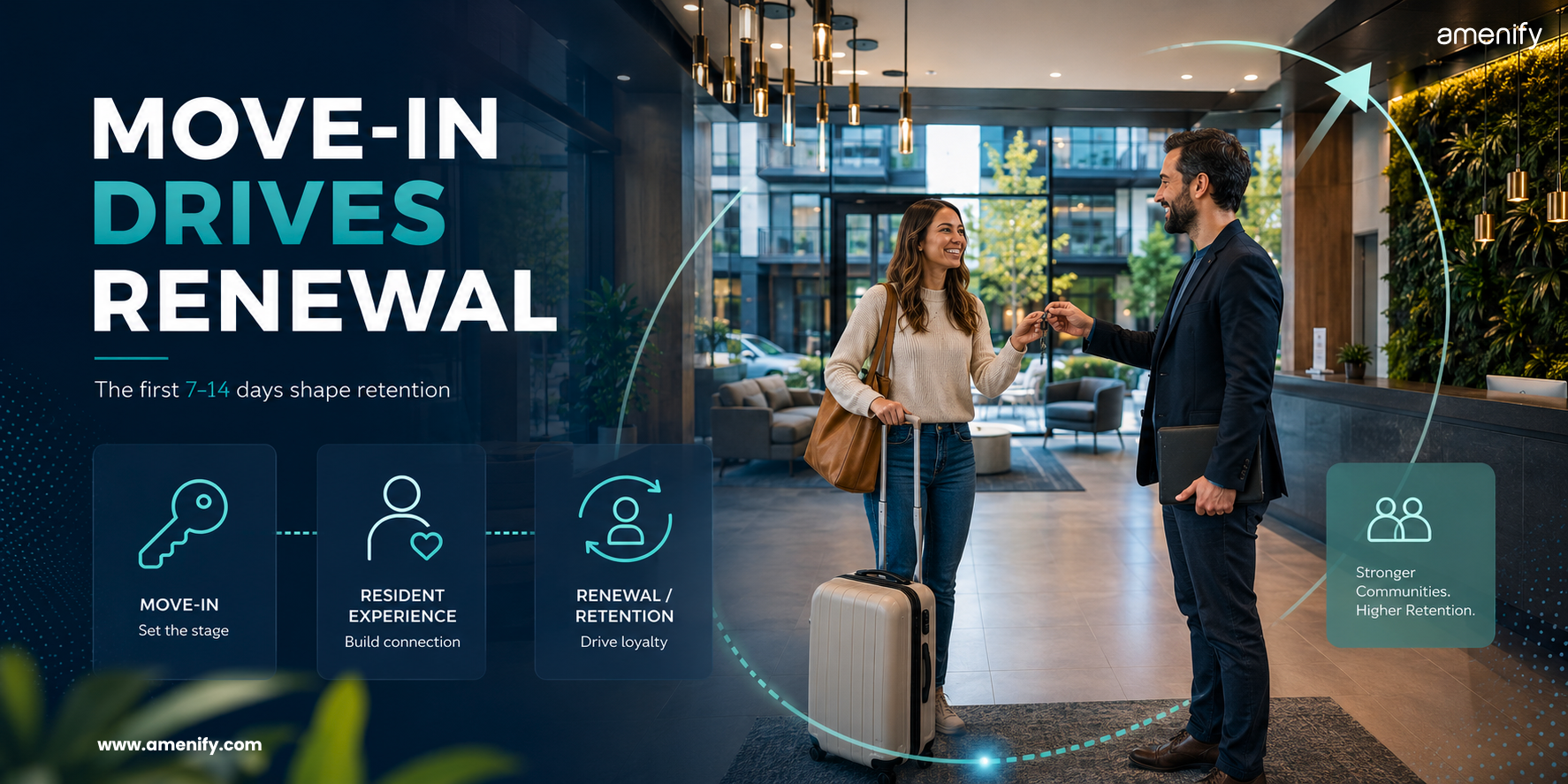
It starts when the resident signs the lease. It picks up during the first 7 to 14 days. And in many cases, it is shaped by the move-in experience long before a renewal offer ever goes out.
That matters more in 2026. AppFolio’s latest renter research found that residents who are satisfied with their move-in are 31% more likely to plan to renew. More broadly, satisfied renters are 72% more likely to renew and 34% less likely to plan a move. That moves move-in out of the hospitality bucket and into the performance conversation.
Move-in is not just a handoff. It is one of the earliest and clearest retention signals in the resident lifecycle.
Move-in still feels more fragmented than operators want to admit
From the operator side, move-in can look straightforward. The lease is signed. The unit is ready. Instructions go out. The team moves to the next priority.
From the resident side, it often feels very different.
Move-in usually comes with a chain of disconnected steps: lease paperwork, insurance, utilities, key pickup, app access, gate or parking setup, service requests, amenity details, package procedures, and a steady stream of practical questions that do not always land in one place.
The friction is rarely dramatic. More often, it is cumulative. AppFolio describes guided move-in workflows as a way to compress processes that once took a week, two phone calls, and three emails into something far simpler. That gets to the heart of the issue: the move-in problem is usually not one major failure. It is the buildup of small unresolved tasks that make the resident feel like they are doing the coordination themselves.
The larger operators have already started designing around that reality.
Greystar now directs residents into a centralized support experience that covers everything from the application process to moving in, while its resident app supports rent, maintenance, communication, and even move-in and maintenance inspections from a mobile device.
Morgan Properties has built a similar expectation into its resident app environment, positioning one mobile touchpoint around rent, maintenance, and routine community tasks.
AvalonBay is pushing convenience from a slightly different angle. Its resident-facing experience now centers on a digital app for payments, maintenance, events, and amenities, while its broader offering leans into furnished apartments and move-ready convenience in select communities.
None of these moves, on their own, “solve” move-in. But together they point in the same direction: away from fragmented first-week logistics and toward a more managed onboarding experience.
Residents can handle complexity.
What they don’t forgive is uncertainty.
This is where a lot of move-in strategies break down.
Residents know moving is complicated. What they do not respond well to is confusion. They are not expecting perfection. They are expecting clarity, responsiveness, and some sense that the property is coordinated.
When that does not happen, the pattern is familiar.
The apartment is technically ready, but the experience is not
The unit may be available, but access, instructions, and setup still feel incomplete.
The information exists, but not in the right order
Residents receive what they need, but not in a sequence that helps them navigate the first few days with confidence.
The support channels are there, but they feel fragmented
Questions about services, logistics, and community processes bounce between departments or require extra follow-up.
The promise sounds polished, but the first week feels manual
The community markets convenience, service, and ease, but the actual move-in experience feels disjointed.
That gap shapes perception quickly.
AppFolio’s 2026 research found that 78% of renters say convenient and financially valuable services matter when evaluating a new home, yet only 33% say they can rely on their property manager to provide those services.
The issue is not just benefits. It is delivery. Operators know residents value convenience. The harder part is making that convenience feel real during the most stressful stretch of the relationship.
And once that gap opens early, it tends to shape how residents interpret everything that follows.
The best operators are treating move-in like onboarding
One of the more important shifts in multifamily is that stronger operators are starting to treat move-in as a managed onboarding period, not a one-day event.
That changes the goal.
Instead of simply getting the resident into the unit, the focus becomes reducing friction before arrival, simplifying first-week tasks, making support more visible, and helping the resident understand how the community actually works from day one.
This is increasingly how resident experience platforms frame the challenge.
AppFolio positions move-in as part of a broader lifecycle strategy tied to satisfaction, efficiency, and long-term retention.
At the operator level, the pattern is visible in the way larger PMCs are investing in resident apps, centralized support, digital inspections, and one-place task management.
Greystar’s mobile experience includes move-in inspections.
Morgan emphasizes a single resident touchpoint for routine community needs.
AvalonBay is building around an app-led living experience designed to reduce day-to-day friction.
That matters because residents do not experience leasing, move-in, support, and service as separate functions. They experience them as one system.
Increasingly, operators have to design around that reality.
Where the mess still lives
The industry has made real progress on automation, self-service, and digital communication. But the move-in window still holds one of the messiest operating gaps in multifamily.
It usually shows up in a few predictable places.
Friction right after lease signing
Residents are committed, but not yet fully supported like active members of the community.
A first week that lacks coordination
Even well-run teams often leave residents piecing together access, services, expectations, and support on their own.
Experience initiatives that create more work
Some programs promise convenience but end up adding administrative burden for onsite teams.
A weak connection between move-in and retention
Too many operators still treat move-in as a completed task instead of a leading indicator of renewal.
That last point deserves more attention. Multifamily is good at measuring lagging indicators like renewal rates, notices, turn costs, and response times. But if move-in satisfaction materially improves renewal intent, then move-in quality belongs much closer to the center of the retention strategy.
Why this hits retention, renewal, and NOI
The logic is pretty simple.
A smoother move-in builds trust earlier.
Trust reduces friction.
Lower friction improves satisfaction.
Higher satisfaction increases the odds of renewal and reduces avoidable turnover.
For operators, the impact compounds.
Stronger retention protects occupancy. It reduces turn costs. It lowers disruption. It gives onsite teams more stability. And in a market where revenue growth is harder to drive through rent alone, it helps preserve income consistency across the portfolio.
There is also an efficiency story underneath this. When move-in is disorganized, teams spend more time answering preventable questions, chasing setup issues, clarifying processes, and repairing resident confidence. That drag may not sit neatly on one line of the budget, but it shows up in labor strain, service inconsistency, and lost time. The large operators building centralized support, digital inspection tools, and resident apps are responding to exactly that pressure.
That is why move-in now belongs in a performance conversation, not just a hospitality conversation.
Where Amenify fits
This is where Amenify becomes relevant in a practical way.
The multifamily industry does not need more generic language about delighting residents. It needs better ways to make the first days of residency feel coordinated, useful, and manageable for onsite teams.
Amenify’s value sits in that operating gap between promise and delivery. By helping third-party property managers bring together resident-facing services, concierge-style support, move-in touchpoints, and automated gifting programs, it contributes to a more organized early resident experience.
That matters because the move-in period is often where resident perception gets set. When the first week feels supported and cohesive, residents are more likely to interpret the broader community experience positively. When it feels fragmented, that tone is much harder to recover from later.
Amenify’s own Square One Management case study points in that direction: pairing gifting with concierge-led onboarding was associated with $122 per unit in savings and a 35% lift in NPS. Even viewed conservatively, the signal is clear. Early resident touchpoints carry more operating leverage than many teams still account for.
For a regional operator or large PMC reading this, the takeaway is not to add one more resident perk. It is to fix the early-resident mess more systematically. If the first 7 to 14 days are already shaping lease outcomes, this is where better operating design starts to matter.
The bigger shift
The most important change here is not tactical. It is strategic.
Move-in is no longer just a checkpoint between leasing and residency. It is increasingly one of the most consequential windows in the entire lease lifecycle.
That is because residents form operating judgments early. They decide whether the property feels responsive, whether the team feels organized, and whether the value proposition is real. Those impressions do not stay isolated to move-in week. They shape how residents interpret every future interaction.
That is why the smartest operators are starting to treat move-in differently.
Not as paperwork.
Not as a task list.
Not as a one-day event.
But as the first real renewal strategy.
